


Hot Keywords:
- All
- Product Name
- Product Keyword
- Product Model
- Product Summary
- Product Description
- Multi Field Search


Views: 0 Author: Site Editor Publish Time: 2026-07-19 Origin: Site


Joining projection screen fabric without visible seam lines, without adhesive residue, and without compromising image quality. That is what RF welding does, and that is what we build machines for.
Hipower has manufactured RF (high frequency) welding equipment since 2000. Over 20+ years, we have supplied welding solutions to projection screen manufacturers across Asia, Europe, and the Middle East. This page covers how RF welding works on screen fabric, what machines we offer, and which option fits your production line.
Standard projection screen material comes in fixed roll widths. When the finished screen is wider than the roll, panels must be joined together. This is where most manufacturers run into trouble.
Sewing leaves a raised thread line across the screen surface. When light hits it during projection, the seam shows as a visible stripe. For cinema screens and high end home theater setups, this is unacceptable.
Adhesive bonding works initially, but UV exposure and heat cycling cause the glue layer to yellow and delaminate over 12 to 18 months. The bond strength degrades, and the fabric separates along the seam under tension.
Thermal pressing risks overheating the PVC or TPU coating, causing surface distortion and uneven light reflection.
RF welding eliminates all three problems. The high frequency electromagnetic field heats the material from within the molecular structure, fusing two layers into a single bond without surface damage. The result is a seam that is as strong as the original material, with no visible line on the projection surface.
The process is straightforward:
Two pieces of projection fabric are overlapped on the welding bed, typically 15 to 25mm overlap depending on material thickness.
An upper electrode (die bar) presses down onto the overlap area with controlled pneumatic pressure.
The RF generator sends a 27.12 MHz electromagnetic field through the material. Polar molecules in the PVC or TPU coating begin oscillating rapidly, generating internal friction heat.
The coating layers reach fusion temperature (typically 130 to 160°C for PVC based screen fabric) and bond at the molecular level.
The electrode holds pressure during a brief cooling phase. Total cycle time is 3 to 8 seconds depending on seam length and material.
Because the heat is generated inside the material rather than applied from outside, the surface on both sides remains smooth and undamaged. This is why the weld appears invisible on the finished screen.
Built for manufacturers who need to weld full width panels in a single press cycle.
| Specification | Detail |
|---|---|
| Max weld length | 1.6 meters or longer per press (customizable) |
| RF power | 8KW to 25KW depending on seam length |
| Operation | Pneumatic automatic, PLC controlled |
| Electrode | Custom profiled die bar matched to your fabric type |
| Best for | High volume production lines, cinema screen manufacturers |
| Specification | Detail |
|---|---|
| Max weld length | 1 meter per press |
| RF power | 5KW to 8KW |
| Operation | Pneumatic, semi automatic |
| Electrode | Standard flat bar (custom profiles available) |
| Best for | Mid volume production, multiple product types sharing one machine |
| Specification | Detail |
|---|---|
| Max weld length | Based on die/mold size (typically 200 to 400mm) |
| RF power | 2KW to 5KW |
| Operation | Manual foot pedal |
| Electrode | Interchangeable die sets |
| Best for | Prototyping, small orders, repair shops, R&D departments |
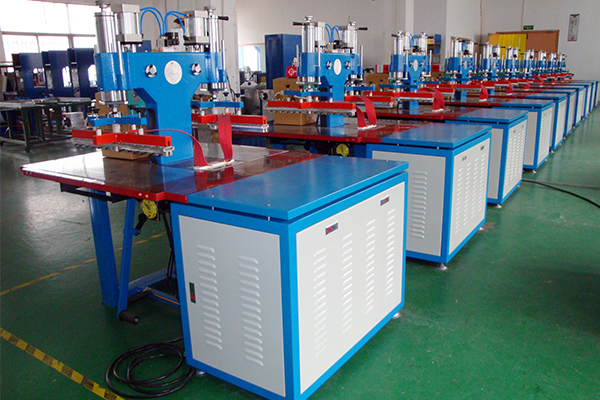
02. Standard machine, it can weld 1 meters each press

Established manufacturer, not a trader. We design and build our own RF generators, frames, and control systems in Shenzhen. When something needs adjusting for your specific material, our engineers handle it directly.
In production since 2000. 25+ years of RF welding machine manufacturing. We have seen most material types and edge cases that come up in real production environments.
Application engineering support. We don't just ship a machine. We test your material, recommend the right power and electrode profile, set the welding parameters, and verify sample quality before the machine leaves the factory.
Machines operating in 35+ countries. Screen fabric manufacturers, tent and membrane fabricators, medical bag producers, and automotive interior suppliers across Southeast Asia, Europe, Middle East, South America, and Africa.
Tell us what you are welding and how wide your seams need to be. We will recommend the right machine configuration and run a sample weld on your material at no cost.
Check out our product team. Please feel free to contact us for more info. Thanks.

